Abstract
The New Cognitive Paradigm (NCP) argues that the central problem of artificial intelligence is no longer whether a system can imitate human outputs, but whether cognition itself can be made structurally measurable.
It replaces behavioural, anthropocentric, and purely phenomenological accounts of intelligence, consciousness, language, and truth with a measurement programme based on internal organization: intrinsic dimensionality, topology, functional regimes, semantic trajectories, memory-like persistence, recovery, and controlled state transitions.
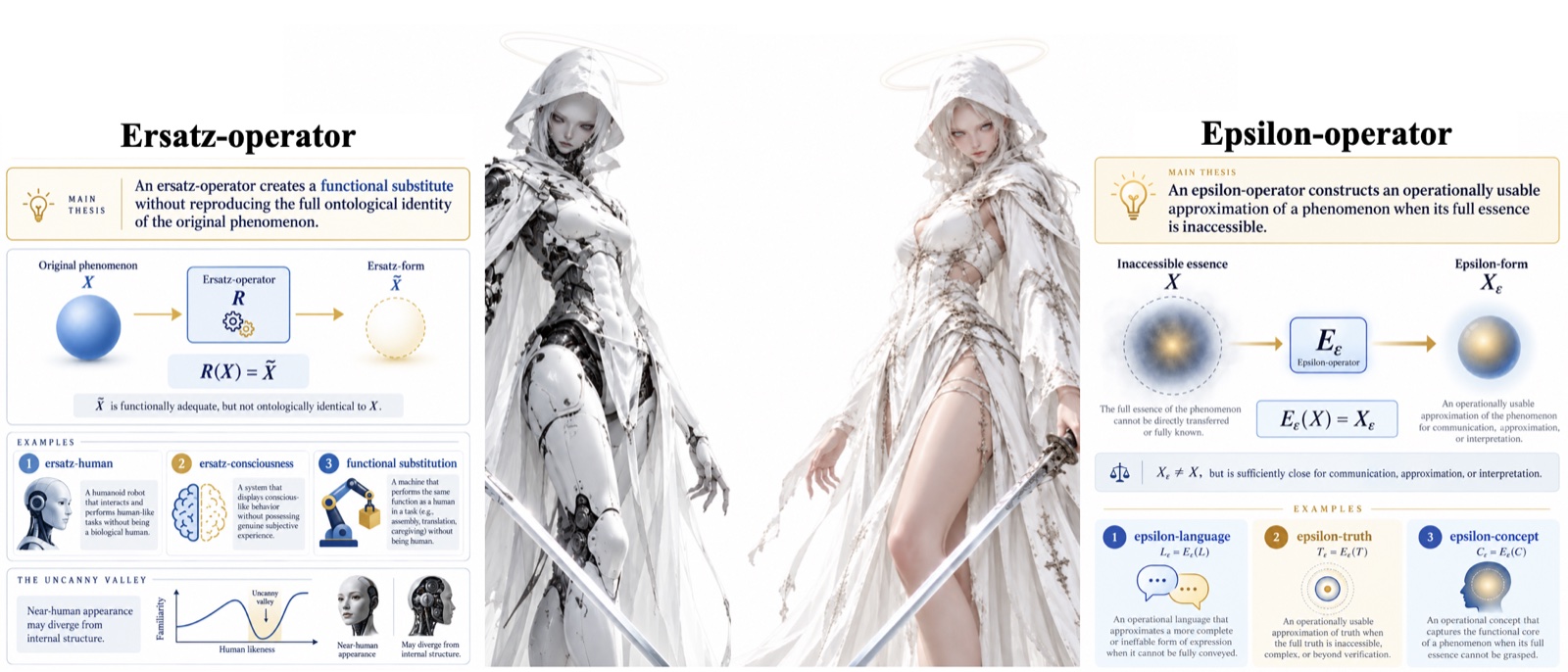
The paper introduces three operational instruments of this paradigm: the epsilon-operator, which constructs a usable near-form of an inaccessible phenomenon; the ersatz-operator, which produces a functional substitute without ontological identity; and the operator of measurability, which turns subjective, interpretive, and phenomenological phenomena into structurally addressable objects (Figure 1).
Within this framework, strong artificial intelligence is not defined as human-like performance, but as measurable structural excess beyond the training envelope. Consciousness is treated as a structurally measurable and potentially modifiable regime rather than only a private phenomenological state. Language becomes semantic state transfer, including intercortical languages, human–machine languages, and machine-to-machine languages. Truth becomes probabilistic truth, understood not as relativism, but as structured access to truth under generative uncertainty.
If the level of consciousness is determined by structure and dynamics, then consciousness is not only describable but also trainable: the NCP opens the possibility of inducing, stabilizing, and amplifying desired conscious or near-conscious regimes through directed neuroplasticity, brain–computer interfaces, neurofeedback, and controlled regime modulation.
The NCP therefore proposes a new criterion for the post-generative era: to distinguish intelligence from imitation, consciousness from ersatz-consciousness, language from token sequence, and truth from fluent plausibility by measuring and shaping the internal structures that make cognition possible.
Keywords: strong artificial intelligence; probabilistic truth; trusted generative AI; structural intelligence; semantic trajectories; BOID; MSSA; language topology; intercortical language; machine-to-machine language; artificial cognition; AI safety; measurable consciousness; measurable creativity
The full text is available as PDF (18 pages).
The talk April Theses of NCP (2026) — conceptual theses on the measurability of intelligence, language and truth, and on probabilistic truth and its non-multiplicity — is registered as a separate record, doi:10.13140/RG.2.2.20527.50087; the preprint above is doi:10.13140/RG.2.2.31157.44001. Both resolve to this page.